Early trapper / Self-carver of Grave Marker
Born: 1693, Scotland (presumed)
Died: (4 May) 1758, Columbia, Pennsylvania
William Campbell’s grave marker is one of Mount Bethel Cemetery’s oldest legible stones. Certainly, it marks one of the earliest inhabitants of Wright’s Ferry (before it was named Columbia) to be buried there. William was, most likely, a trapper. That, in itself, isn’t particularly unique, but the story of how the stone may have been carved certainly is.
The story which has followed this stone marker from the late 18th century may be completely accurate, OR the story may have been embellished over the years. The story goes:
William Campbell’s canine companion was surely a loyal assistant and a comfort as William trapped the lands up and down the Susquehanna River valley. Sadly, William discovered that the poor creature had contracted an infection (rabies?). Uncharacteristically, the dog bit William when he released the dog from a trap. A few days later, William developed a fever which soon was followed by confusion and agitation.
William Campbell was obviously a practical and pragmatic man and very soon understood that his trapping days might soon come to an end, along with everything else. He surmised there was no time to waste. After dispatching his poor, suffering companion with his knife, he realized what had to be done next.
With one bandaged hand—getting more painful with each passing hour—he found a piece of slate he roughly shaped and set about carving the basic facts of his life into its surface. He augmented those facts with a rough illustration of what transpired: a dog lying on its side, a glove-covered hand holding a knife pointing toward the dead beast. To the contemporary mind, it’s a mystery how he could have possessed the will, tenacity, and strength to carve letters and images into a slab of slate in the condition he was experiencing. Because of that dubious belief, some have suggested he got only so far when someone else must have helped him finish his task. Considering, too, the feat to dig a hole deep enough for William, the dog, and the slate slab—all the while fighting a fever—it seems rather likely that someone at some point assisted him. Men and women of that time and in such a place were built of harder stock. This story only supports that premise. But, perhaps, it was only a story brought about by conjecture and the love of reciting a dramatic tale.
Nineteenth century Columbia historian, Francis X. Reuss, offered an alternate assessment of the story during his 1903 research and, thus, what is carved into the stone. Mr. Reuss posits that the ‘dog’ and ‘hand holding knife’ might suggest alternate imagery. Instead of a dog lying dead, he suggests it could be Scotland’s iconic ‘lion rampant’ (on hind legs) on ‘sinister’ (facing left). There are certainly numerous crests in the United Kingdom which used such symbology. The ‘hand with knife,’ Mr. Reuss suggests, is a ‘dexter (right) mailed hand’ holding a sword or knife. He thoroughly researched his theory but could not come away with firm evidence. Afterall, he didn’t have the benefit of the internet to research it as thoroughly as we can today. His theorgy is a viable one. Indeed, the crest of Scotland’s Clan Gunn shows almost a precise example of the ‘hand and blade’—perhaps William was honoring his country of birth—the lion—and his mother’s clan? It’s a viable explanation. When one considers how difficult it may have been to carve illustrations of a lion and hand with blade into slate, it’s not overly taxing to understand why the illustrations aren’t clear and precise, leaving them open for a wider interpretation.
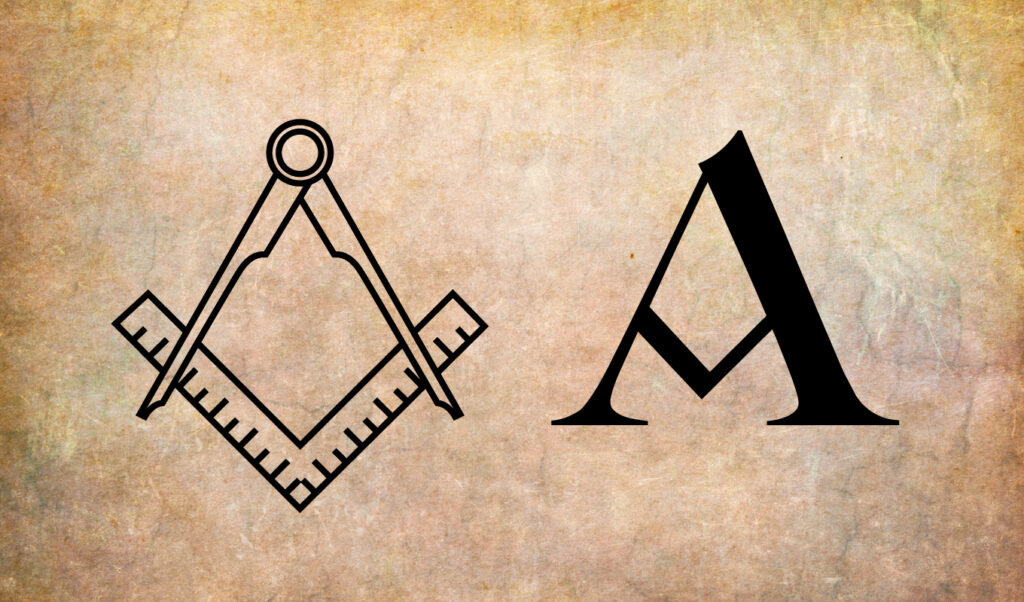
Recently, yet another interesting detail has come to light which suggests another possibility about who William was—or, what he was. Within the words carved on his stone is the letter “A,” six times. Five of the six show the letter in uppercase form, and three of those uppercase “A” letters show the horizontal stroke as a “V” shape—a form of the letter often considered to be Masonic (as it suggests the shape of the builder’s square and compass symbol). Was William a Mason, and had he come from a more influential family rather than generations of trappers? We’ll probably never know, but it’s an interesting and intriguing hypothesis.
If you’ve recently visited the Mount Bethel Cemetery, you’ll notice that William’s stone doesn’t exist where it had been placed many years ago. Weather has taken its toll. In the early part of 2026, the marker was removed from his resting place of 268 years and lovingly relocated inside the cemetery cottage for protection against the elements.
___________
A note about William’s spelling and dated word forms:
During this time, what looks like a lowercase ‘f’, when used at the beginning or middle of a word, is pronounced like an ‘s.’ Known as a ‘long S’ or ‘medial S’ it is an archaic letterform which pretty much ended at the beginning of the 19th century. Interestingly, William used it at the end of words. Either the usage changed after the move to the Colonies, or he was simply in error.
After ‘May,’ Willian appears to have chosen ‘ye.’ Initially, the letter used on the other side of the Atlantic looked like a fancy lowercase ‘p,’ with a bit of a curled flourish at the top of the P’s vertical stem. It was known as the letter ‘thorn.’ When that letter fell out of favor with the popularity of print, it was replaced by a ‘Y,’ with a lowercase ‘e’ appearing right above or at the upper right of the Y. As we’ve all seen in old English, it became ‘Ye.’ which simply meant ‘the.’ In William’s usage, he seems to have used it as a shorthand version meaning “in the year” as it precedes 1758.
There are alternative sources which suggest the death date reads: ‘May ye 4th 1758.’ If this notation was made previous to a section of the stone which crumbled away, it’s reasonable to believe that, on the next line, “4th” could have existed before the year. No existing photographs demonstrate this, but the images we’ve seen only go back as far as the 1930s. And, IF the day of his death is mentioned, it’s very unlikely William was the one who produced that portion of the carving.
We’ve used the word “parted” as in “…parted this life.” However, it’s quite possible that some letters may have broken away (slate being a layered stone), we should consider the possibility that he actually carved “Departed.” In either case, the meaning similar.
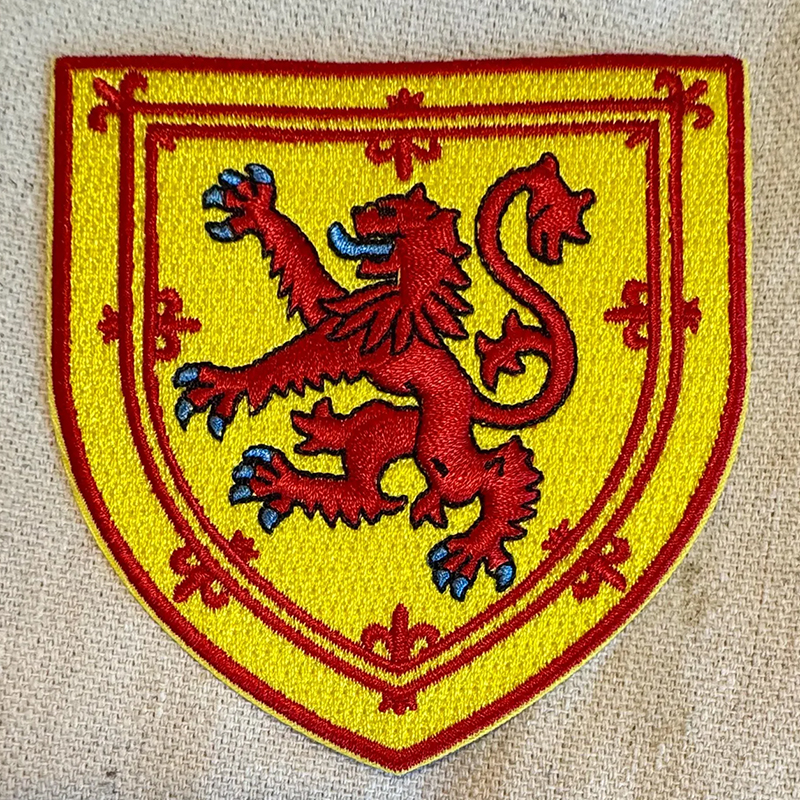
The Lion of the Scots, rampant on sinister (facing left).
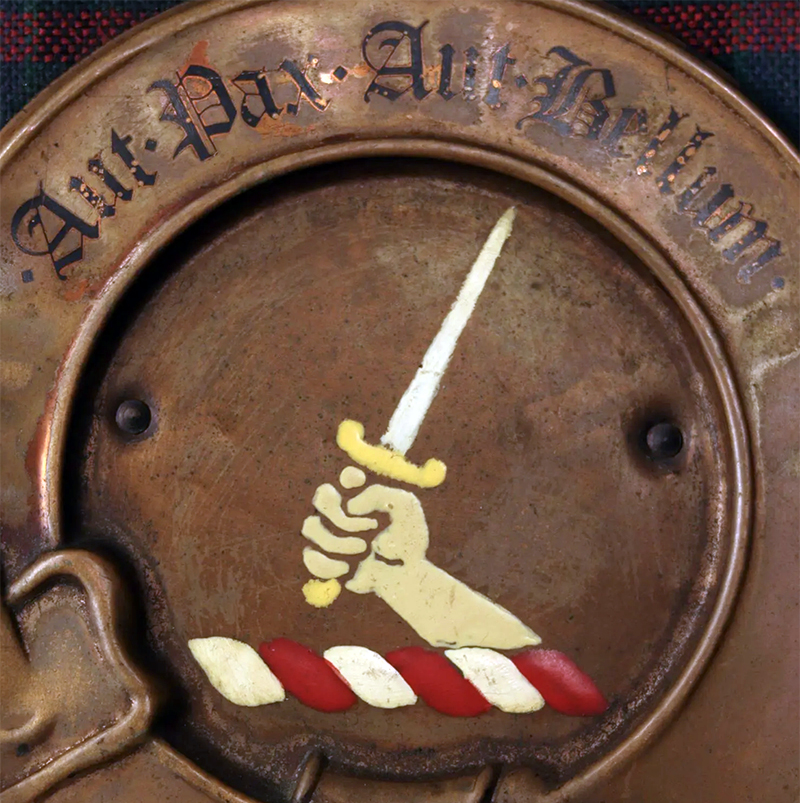
Symbol of Clan Gunn along with “Aut Pax. Aut Bellum.” (meaning: “Either peace, or war.”).
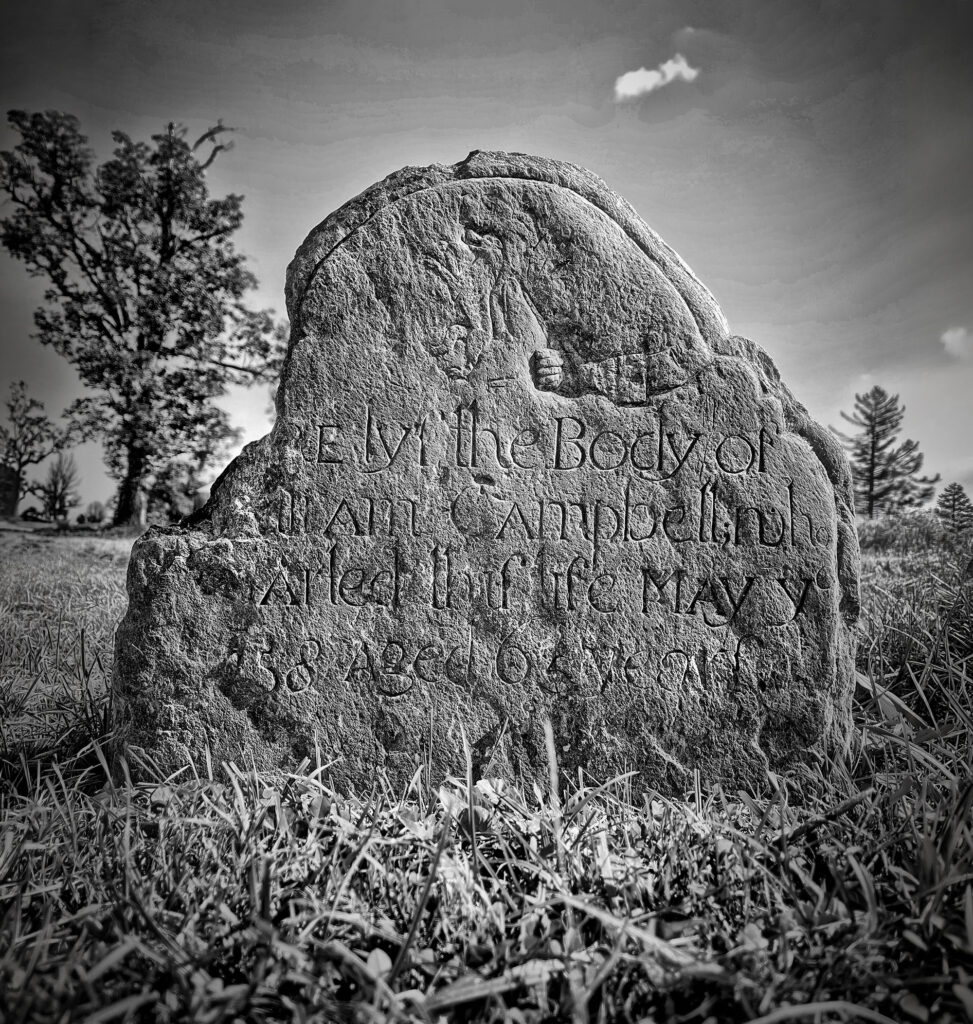
The William Campbell self-carved grave marker in situ, photographed January 2026
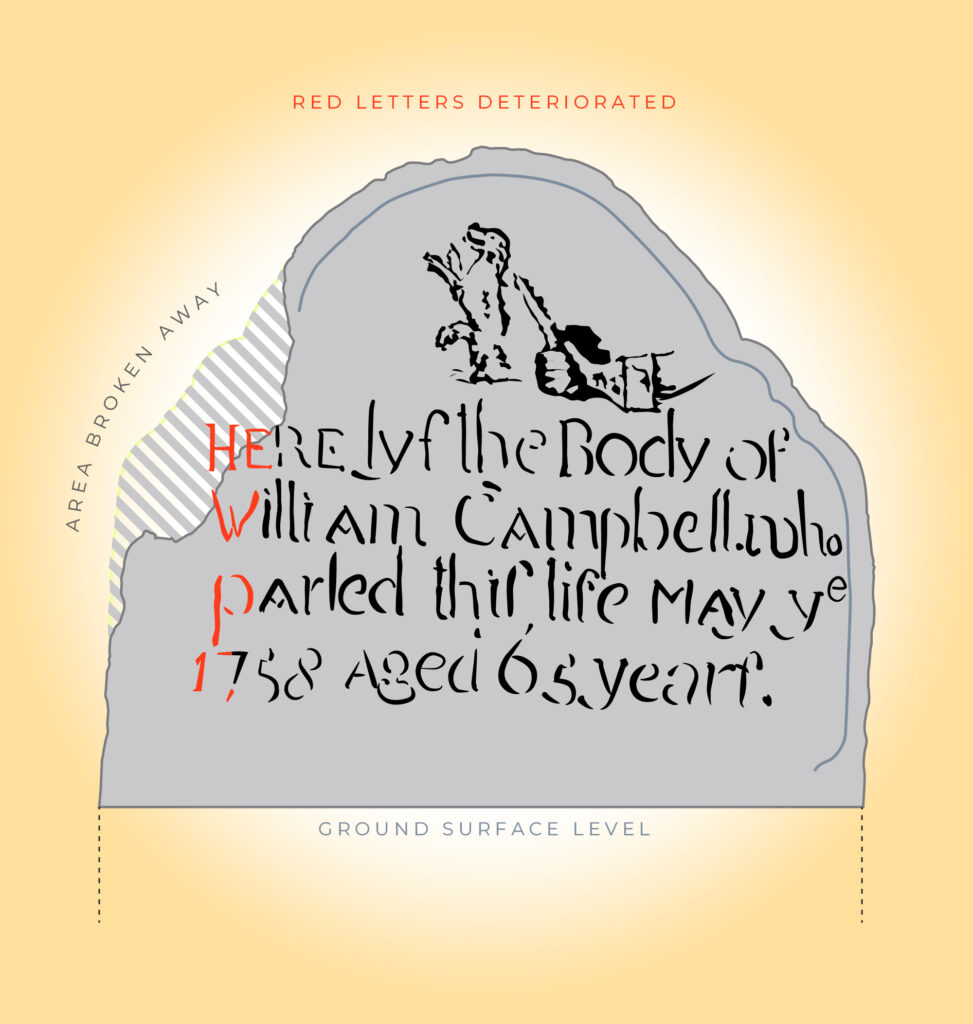
Graphic of the Campbell grave marker emphasizing the carved letters with dog and hand holding a knife